
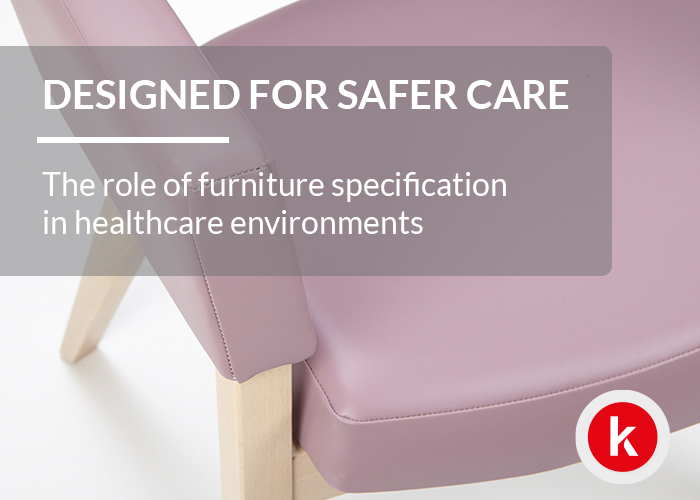
Designed for safer care: the role of furniture specification in healthcare environments
Every detail within a healthcare environment has the potential to influence how a space is experienced and used.
From clinical procedures and working practices to the physical environment itself, creating safer care settings requires consideration at every level.
That includes furniture.
This World Patient Safety Day, marked globally on 17 September, provides an opportunity to consider the many different elements that contribute to safer healthcare environments.
The World Health Organization’s theme for 2026 is “Safe care for noncommunicable diseases”, supported by the slogan “Safe care for life!”. The campaign highlights the importance of making safety and quality a priority throughout the continuum of care.
While furniture represents only one element of a much wider approach to patient safety, appropriate specification can help create environments that better support patients, residents, visitors and healthcare teams.
Safety starts with understanding the environment
There is no single piece of furniture that is suitable for every healthcare setting.
A chair specified for a general hospital waiting area may need to meet very different requirements from seating used within older persons’ care, rehabilitation, behavioural health, mental health or other specialist environments.
Good specification therefore starts with understanding who will use the furniture, how it will be used and the environment in which it will be placed.
The needs and risks associated with the individual setting should inform decisions around construction, materials, dimensions, functionality and product detailing.
Taking this considered approach can help ensure furniture is appropriate for its intended application rather than simply selecting a product based on appearance.
Supporting stability and movement
Sitting down and standing up are everyday movements, but they can become more challenging for people experiencing reduced mobility, weakness or other health conditions.
Furniture proportions can make an important difference.
Seat height and depth, supportive armrests, appropriate back support and the overall stability of the product should all be considered when specifying seating for environments where users may require additional support.
A chair that feels stable and dependable can provide reassurance while its dimensions and form can help support everyday movement and transfers.
Where mobility requirements are particularly important, specification should form part of a wider assessment of the individual’s needs and the care environment.
Considering furniture placement
The product itself is only part of the equation.
How furniture is positioned within a room can also influence how safely and easily people are able to navigate the environment.
Healthcare interiors often need to accommodate patients, visitors, care staff, mobility aids and clinical equipment simultaneously.
Maintaining appropriate circulation space and considering the relationship between furniture, doorways, walkways and other equipment can therefore be just as important as the individual furniture specification.
A thoughtfully planned environment should allow furniture to fulfil its intended purpose without creating unnecessary obstacles or making it more difficult for people to move around the space.
Designing for demanding environments
Healthcare furniture can experience considerably different patterns of use from furniture within a typical domestic environment.
Products may be used frequently and by people with a wide variety of needs. In many settings, furniture must also withstand regular cleaning and ongoing use over an extended period.
Robust construction and materials appropriate to the intended environment should therefore be important considerations during specification.
Structural stability, appropriate fixings and considered product detailing can all contribute to furniture better suited to demanding healthcare environments.
Different settings will require different levels of performance, making it important to assess products against the requirements and risk profile of the environment in which they will be used.
Cleanability as part of safer care
Maintaining healthcare environments requires furniture that can be incorporated practically into established cleaning routines.
The construction of the product can make a difference.
Materials and finishes, upholstery, seams, joins and areas that are difficult to access should all be considered when evaluating how straightforward a piece of furniture will be to clean and maintain.
Reducing unnecessary areas where dirt or debris may accumulate can help simplify everyday cleaning, while surfaces and upholstery should be selected according to the cleaning and disinfection requirements of the intended setting.
Manufacturer cleaning guidance should always be followed alongside the infection prevention procedures established by the individual healthcare provider.
Selecting appropriate materials
Furniture specification also means looking beyond colour and aesthetics.
Materials should be selected according to the requirements of the environment and may need to balance durability, cleanability, comfort and performance.
Upholstery is a good example.
The most appropriate fabric for a low-risk residential-style care environment may be different from that required within an acute healthcare or specialist mental health setting.
Understanding the expected use of the product, cleaning requirements and relevant performance standards can help specifiers make more informed material choices.
Details can make a difference
Safety considerations are often found in the smallest details.
Depending on the environment and intended user group, this might include considering:
- stable and appropriately proportioned furniture
- supportive armrests
- appropriate seat heights
- robust frames and construction
- secure fixings and components
- carefully considered edges and corners
- furniture layouts that support clear circulation
- materials suitable for regular cleaning
- minimised seams, gaps and difficult-to-access areas
- appropriate mobility features, such as lockable castors where required
- specialist design features appropriate to higher-risk healthcare settings
Not every feature will be relevant to every environment.
The important point is that these considerations form part of the specification process from the beginning rather than being addressed as an afterthought.
Safety without losing sight of the person
Designing safer environments does not mean creating spaces that feel unnecessarily institutional.
Comfort, dignity and familiarity remain important considerations.
Within environments such as residential care, dementia care and longer-stay healthcare settings, furniture can combine practical healthcare requirements with familiar forms, softer aesthetics and warmer finishes to help create spaces that feel more welcoming.
The aim should be to balance the physical requirements of the environment with the experience of the person using it.
A well-considered healthcare interior can feel supportive and reassuring while still responding to practical requirements around durability, maintenance and safety.
A considered approach to safer healthcare environments
World Patient Safety Day reminds healthcare organisations, professionals and those involved in creating healthcare environments of the importance of continuing to identify opportunities to reduce avoidable harm and improve the quality and safety of care.
Furniture specification is only one part of that much larger picture, but it is a part worth considering.
By looking carefully at the user, application, environment and potential risks, architects, designers, specifiers and healthcare providers can make more informed decisions about the furniture they introduce into a space.
From stability and cleanability to materials, construction and spatial planning, thoughtful design decisions can contribute to healthcare environments that are better suited to the people who use them.
Because when it comes to safer care, even the smallest details should be designed with purpose.
World Patient Safety Day 2026
World Patient Safety Day takes place on 17 September 2026. This year’s World Health Organization campaign focuses on safe care for noncommunicable diseases, with the slogan “Safe care for life!”, encouraging action to improve patient safety throughout people’s care journeys.
Comments are closed here.