
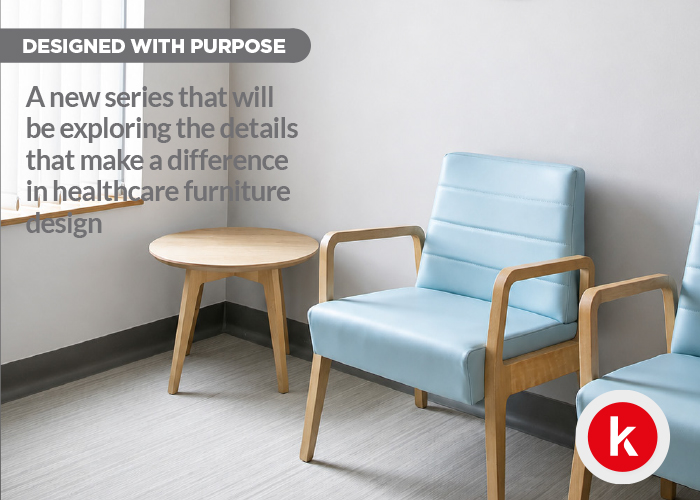
Designed with Purpose: the details that make a difference in healthcare furniture
Healthcare furniture is about much more than how a product looks.
The environments in which healthcare furniture is used can be complex, with the needs of patients, residents, visitors and care teams all needing to be considered. From hospitals and rehabilitation settings to care homes and longer-stay environments, furniture has an important role to play in how a space feels, functions and supports the people within it.
Thoughtful healthcare furniture design brings together a wide range of considerations, many of which may not immediately be visible.
Comfort, stability, cleanability, familiarity and safety can all influence the experience of a space and the suitability of a piece of furniture for its intended environment.
In our Designed with Purpose series, we explore five of these important considerations and how they can help shape more supportive, practical and person-centred healthcare interiors.
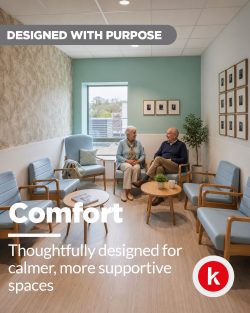
Comfort: supporting everyday wellbeing
Comfort can play an important role in how a healthcare environment is experienced.
People may use healthcare seating while waiting for an appointment, receiving treatment, resting, socialising or spending extended periods of time within a space. The requirements can therefore be very different from those of furniture designed for less demanding environments.
Supportive forms, appropriate proportions and carefully selected materials can all contribute to a more comfortable experience.
Comfort should be considered from the beginning of the design process rather than treated simply as an additional feature. The shape of the backrest, seat height, arm positioning and level of support can all influence how a piece of furniture feels and how easily it can be used.
Creating a comfortable environment can also help healthcare spaces feel calmer and more welcoming, supporting wellbeing alongside the practical requirements of the setting.
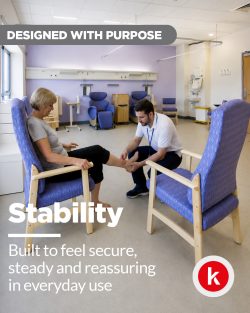
Stability: creating a greater sense of security
In healthcare environments, feeling secure matters.
Furniture designed with stability in mind can provide reassurance during everyday use, particularly in environments supporting older people, those undergoing rehabilitation or anyone who may require additional assistance when sitting down or standing up.
A well-balanced structure, robust construction and considered proportions can all contribute to furniture that feels dependable.
Armrests, seat heights and the positioning of the furniture within a space may also influence how confidently a person can transfer in and out of a chair.
Although stability may not always be an immediately noticeable design feature, it is something users should be able to rely upon.
For healthcare providers, choosing furniture appropriately designed for the demands of its intended environment can help create spaces that feel both supportive and secure.

Cleanability: designed around everyday healthcare routines
Furniture within healthcare environments needs to work practically for the people responsible for maintaining it.
Material selection, surface finishes, upholstery construction and product detailing can all affect how straightforward a piece of furniture is to clean.
Reducing unnecessary joins, seams and difficult-to-access areas can help make routine cleaning more manageable, while appropriate healthcare fabrics and surface materials can support the cleaning and disinfection processes required within a particular setting.
Cleanability should therefore be considered as part of the overall product design rather than simply through the choice of upholstery.
It is also important that cleaning requirements are considered alongside the manufacturer’s care instructions and the infection prevention procedures relevant to the individual healthcare environment.
By designing around real-world cleaning routines, furniture can become easier for healthcare teams to maintain throughout its lifetime.
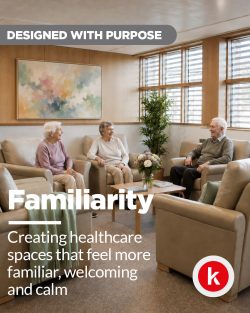
Familiarity: creating environments that feel less clinical
Healthcare environments do not always need to feel institutional or clinical.
Furniture can contribute significantly to the overall character of an interior, and familiar forms, warmer finishes, recognisable materials and more residential styling can help create spaces that feel welcoming and reassuring.
This can be particularly valuable within dementia care, older persons’ services, residential care and longer-stay healthcare environments.
For people spending considerable amounts of time within a setting, interiors that incorporate familiar and homely design cues can support a more person-centred approach.
This does not mean compromising the practical requirements of healthcare furniture.
Instead, it is about combining appropriate construction, materials and performance with an aesthetic that feels more recognisable and less institutional.
The result can be an environment that is designed for healthcare while still feeling closer to home.

Safety: considered from the start
Safety within healthcare furniture is rarely about one individual feature.
Instead, it comes from understanding how a product is likely to be used, who will use it and the type of environment in which it will be placed.
Robust construction, stability, appropriate materials and carefully considered edges, fixings and detailing may all form part of the overall design approach.
Different healthcare settings will also have very different requirements. Furniture appropriate for a general waiting area, for example, may require different considerations from products intended for mental health, dementia, rehabilitation or high-dependency environments.
For this reason, furniture specification should always consider the needs and risk profile of the individual setting.
Good healthcare design brings these practical considerations together without losing sight of comfort, dignity or the overall experience of the person using the space.
Bringing the details together
No single design feature defines good healthcare furniture.
It is the combination of multiple considerations; from how comfortable a chair feels and how securely it supports the user, to how easily it can be maintained and how naturally it fits within its surroundings – that helps determine whether furniture is appropriate for its intended environment.
By considering comfort, stability, cleanability, familiarity and safety throughout the design process, healthcare interiors can become more supportive of the people who use them and more practical for those who care for and maintain them.
Because in healthcare, the details can make a difference.
Designed with purpose. Designed around people.
Comments are closed here.