
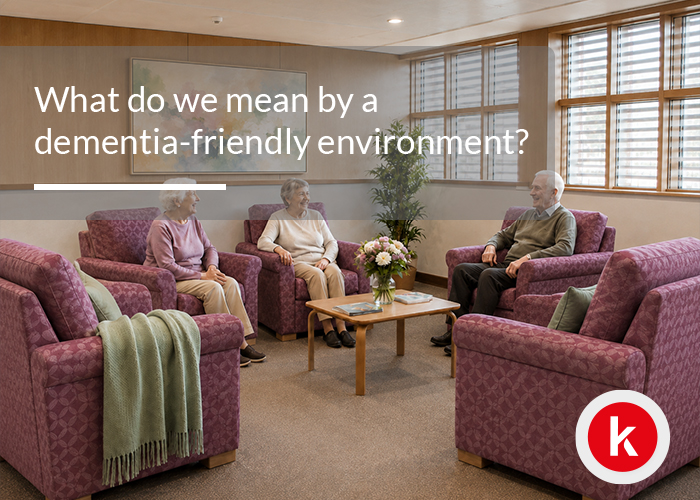
What do we mean by a dementia-friendly environment?
The term dementia-friendly is increasingly used across healthcare, residential care and interior design, but what does it actually mean when we are talking about the physical environment?
At its simplest, a dementia-friendly environment is one that has been thoughtfully designed to help people living with dementia feel safe, comfortable, confident and as independent as possible.
Dementia can affect memory, perception, orientation, judgement and the way a person interprets their surroundings. This means elements of an environment that may seem straightforward to one person can potentially become confusing or difficult for someone living with dementia.
The design of the environment can therefore play an important supporting role.
So, what does dementia-friendly design look like in practice?
Creating spaces that are easy to understand
A dementia-friendly environment should make it as straightforward as possible for someone to understand where they are and where they need to go.
Clear layouts can help reduce unnecessary confusion.
Long, complicated corridors, identical doors or spaces without obvious visual reference points can potentially make navigation more difficult. Instead, interiors can use recognisable landmarks, clearly differentiated areas and logical routes through a building.
Good signage can also help.
Signs should be easy to see and understand, positioned where people are likely to need them and use appropriate contrast between the wording and its background.
The aim is to make the environment communicate more clearly, reducing the amount of information someone needs to remember.
Using colour and contrast thoughtfully
Colour can do much more than establish the visual style of an interior.
Within dementia-friendly environments, contrast can help distinguish important objects and surfaces from their surroundings.
For example, a chair that contrasts clearly with the floor and wall behind it may be easier to identify than seating that visually blends into the room.
Similarly, doors to important destinations, handrails and other features may benefit from being visually distinguishable.
But more colour is not necessarily better.
Too many competing colours, strong patterns or dramatic changes in flooring can potentially make an environment harder to interpret. Patterns or dark areas may be perceived differently by somebody experiencing changes in visual perception.
The objective should therefore be clarity rather than decoration for decoration’s sake.
Choosing furniture that is recognisable
Furniture can make a significant contribution to how familiar and understandable a healthcare or care environment feels.
One important consideration is recognition.
A chair that clearly looks like a chair and a dining table that looks familiar in form can make the purpose of an environment easier to understand.
This is one reason more residential furniture styles are often introduced into dementia and older persons’ care environments.
Familiar forms, timber-effect finishes, warmer colours and softer upholstery can help create environments that feel less institutional while still providing the performance required for a healthcare setting.
This balance is important.
A dementia-friendly care environment should not simply look like a clinical space with a few domestic accessories added. Furniture, finishes, lighting and interior architecture should work together to establish a coherent and recognisable environment.
Helping people see where they are sitting
The relationship between furniture and its surroundings should also be considered carefully.
If the seat, arms and surrounding floor are all similar colours, the edges of a chair may be more difficult for some users to distinguish.
Using suitable visual contrast can make the form of the furniture clearer.
The construction and proportions of seating are important too.
Stable furniture, supportive arms, appropriate seat heights and comfortable back support can all be relevant when specifying furniture for people who may have reduced mobility or require additional confidence when sitting down and standing up.
Furniture specification should always reflect the needs of the intended users and the risk assessment for the particular environment.
Making spaces feel familiar
Familiarity is one of the most important ideas within dementia-friendly design.
People living in residential and long-term care environments are not simply occupying a healthcare facility; it is also their living environment.
Creating spaces that contain recognisable features can therefore help establish a greater sense of place.
Residential-style furniture, familiar artwork, shelving, books, meaningful objects and views into gardens or outdoor spaces can all help an interior feel more relatable.
Personalisation can be particularly valuable.
Photographs, objects and clearly identifiable bedroom entrances can help differentiate one person’s space from another and provide additional visual cues.
A dementia-friendly environment should ultimately feel designed around the person rather than around the institution.
Considering lighting and reflections
Lighting can significantly affect how an environment is perceived.
Good levels of natural light can support comfortable, welcoming interiors and help reinforce the relationship between daytime and night-time.
Artificial lighting should provide appropriate, even illumination while avoiding unnecessary glare and strong shadows where possible.
Reflections also deserve consideration.
Highly reflective floors, glass and polished surfaces can sometimes make an environment visually more complex. The interaction between lighting, flooring and surface finishes should therefore be considered as part of the overall interior rather than independently.
Reducing unnecessary visual and auditory clutter
Healthcare settings can be busy environments.
Multiple signs, equipment, patterned finishes, televisions, conversations and general activity can create a considerable amount of sensory information.
For somebody living with dementia, filtering this information may become more difficult.
A dementia-friendly space does not need to be empty or minimalist, but it should be considered.
Clear visual hierarchies, less unnecessary signage, controlled patterns and opportunities to move into quieter areas can help create a calmer environment.
Supporting independence rather than removing every risk
Dementia-friendly design is not simply about eliminating risk.
An environment that is overly restrictive can potentially reduce a person’s independence and ability to engage with everyday life.
Instead, good dementia-friendly design seeks to create an environment that is understandable and supportive enough for people to continue doing as much as possible for themselves.
This may mean providing clear routes to communal areas, making toilets easy to locate, creating accessible seating points or allowing someone to see their destination rather than relying entirely on signage.
Providing opportunities for social interaction and retreat
Not everyone wants to use a space in the same way.
A good dementia-friendly environment can offer a choice between social interaction and quieter areas.
Large communal lounges may work well for some activities, while smaller seating arrangements can create more comfortable spaces for conversation with friends, relatives or carers.
Furniture placement can help establish these different zones.
Rather than arranging every chair around the perimeter of a room, smaller groups of seating can create more recognisable social settings and help large spaces feel less institutional.
Quiet areas can equally provide somewhere to rest when the wider environment becomes overwhelming.
Connecting with nature and the outdoors
Access to gardens, courtyards and natural views can also contribute to the quality of a dementia-friendly environment.
Windows that provide recognisable views, comfortable seating near natural light and safe access to outdoor spaces can help people maintain a relationship with the outside environment.
Where outdoor spaces are provided, they should be considered with the same attention to accessibility, orientation, seating and navigation as the interior.
There isn’t one dementia-friendly design
Perhaps the most important thing to remember is that there is no single experience of dementia.
People will have different abilities, preferences, backgrounds and personal histories, and these may also change over time.
A dementia-friendly environment therefore cannot be created simply by following a fixed formula or choosing a particular colour palette.
Instead, it requires a person-centred approach that considers how the environment can help people understand their surroundings, maintain independence and feel comfortable within them.
That means bringing together architecture, furniture, lighting, colour, signage, acoustics and familiar details as part of one overall design strategy.
What does this mean for furniture specification?
When specifying furniture for a dementia-friendly healthcare or residential care environment, useful questions to consider include:
- Is the purpose of the furniture immediately recognisable?
- Does it contrast appropriately with its surroundings?
- Does the seating provide suitable support and stability?
- Are its dimensions appropriate for the intended users?
- Does the furniture help the environment feel familiar rather than institutional?
- Are materials appropriate for the practical requirements of the setting?
- Can furniture be positioned to create smaller, recognisable social areas?
- Does its design support the wider wayfinding and interior strategy?
Furniture alone cannot make an environment dementia friendly.
But when it is considered alongside the layout, lighting, signage, colour, acoustics and needs of the people using the space, it can make an important contribution.
Designed around people
Ultimately, dementia-friendly design is about helping the environment do more of the work.
Instead of expecting someone to continuously adapt to a confusing environment, thoughtful design can make spaces easier to understand, navigate and enjoy.
And often, the principles that make an environment more supportive for someone living with dementia, including clarity, familiarity, comfort, good lighting and intuitive design, can make the space better for everyone.
Because a dementia-friendly environment isn’t simply about designing for a diagnosis.
It’s about designing around people.
Comments are closed here.